
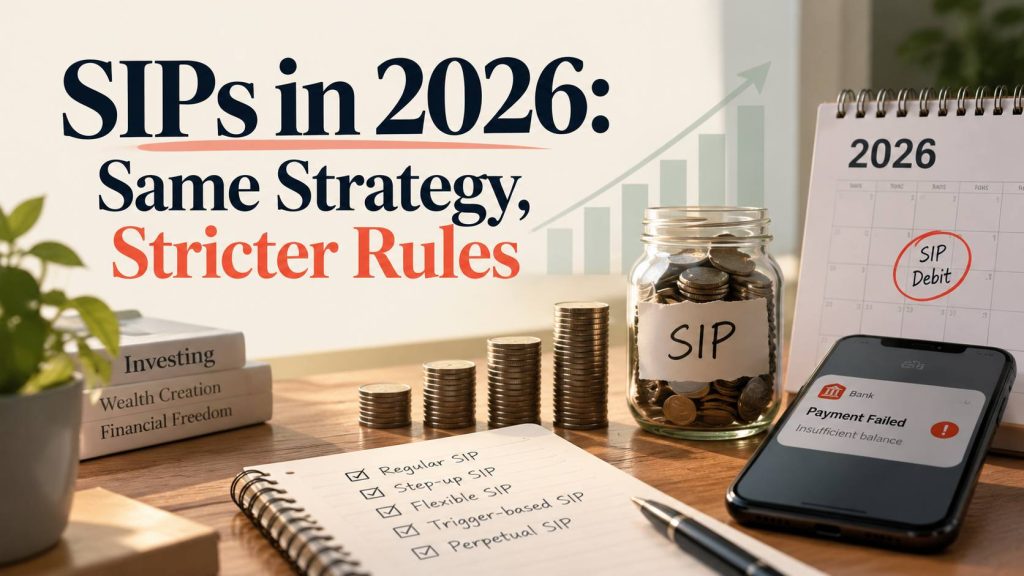
A Systematic Investment Plan has been the default advice for Indian retail investors for so long that most people stopped questioning it. Pick a fund, set a monthly amount, let compounding do the work. That advice still holds. What’s changed is less about the strategy and more about what happens when the plumbing around it fails, and a lot of investors haven’t noticed the shift yet.
The Scale Has Gotten Genuinely Large
SIPs aren’t a niche habit anymore. By May 2026, monthly SIP inflows had crossed ₹30,000 crore, spread across more than 9.6 crore active accounts, with total SIP assets under management touching roughly ₹17 lakh crore. That scale matters because it’s part of why regulators have started paying closer attention to the mechanics behind each instalment, not just the investment itself.
The Real Change
Missed Payments Now Cost More
For years, a missed SIP instalment was a minor inconvenience. Your bank account didn’t have the balance on the debit date, the payment failed, and the SIP quietly continued the next month with little consequence. That’s no longer quite true. In April 2025, SIP cancellations more than tripled in a single month compared to March, and the reason wasn’t investor panic over market conditions. It was a SEBI circular enforcing stricter rules around failed SIP payments. The regulator tightened how payment failures get handled, and insurers and platforms responded by cancelling SIPs that kept failing rather than letting them limp along indefinitely.
The practical implication is simple but easy to overlook: the account linked to your SIP needs to reliably have funds on the debit date now more than it used to. A SIP that keeps bouncing isn’t just losing you a month of investment, it risks getting cancelled outright, and restarting a SIP means losing whatever momentum and discipline you’d built up.
The Variants Worth Knowing
Not every SIP works the same way, and choosing the right variant matters more than people assume:
A flexible SIP lets you adjust your contribution amount based on your cash flow that month
A step-up or top-up SIP automatically increases your contribution every year, useful if your income is growing but your investment amount isn’t keeping pace
A trigger-based SIP only invests when a specific market condition is met, such as a defined percentage fall
A perpetual SIP has no end date and continues until you manually stop it, which suits long-horizon goals where you don’t want to set an artificial deadline
How Taxation Actually Works
Each SIP instalment is treated as a separate investment for tax purposes, not as one lump investment spread over time. That matters when you redeem, because gains are calculated using the FIFO method, meaning your earliest instalments are considered redeemed first. If you’re planning an exit and trying to manage your tax liability, this detail changes how you should think about partial withdrawals rather than assuming a flat, averaged cost basis.
What This Means, Practically
A few things are worth acting on rather than just filing away as background knowledge:
Check that your linked bank account has a buffer before your SIP debit date. A single failure is more consequential than it used to be.
If you’ve had a SIP cancelled due to repeated failures, don’t just let it stay stopped. Restart it deliberately rather than assuming it’ll resume on its own.
Match the SIP variant to your actual financial situation. A flat regular SIP is simple, but a step-up SIP often makes more sense if your income is rising year over year.
When planning a partial redemption, remember the FIFO rule. Your oldest instalments get redeemed first, which affects your holding period and tax treatment.
Where This Leaves Us
The core logic of a SIP, invest steadily, let the market’s ups and downs average out over time, hasn’t changed and probably won’t. What’s changed is the tolerance for sloppiness around the payment mechanics. The investors who keep benefiting from SIPs without friction aren’t doing anything clever with fund selection. They’re the ones who treat the auto-debit date with the same seriousness as an EMI, because at this point, that’s effectively what it is.