
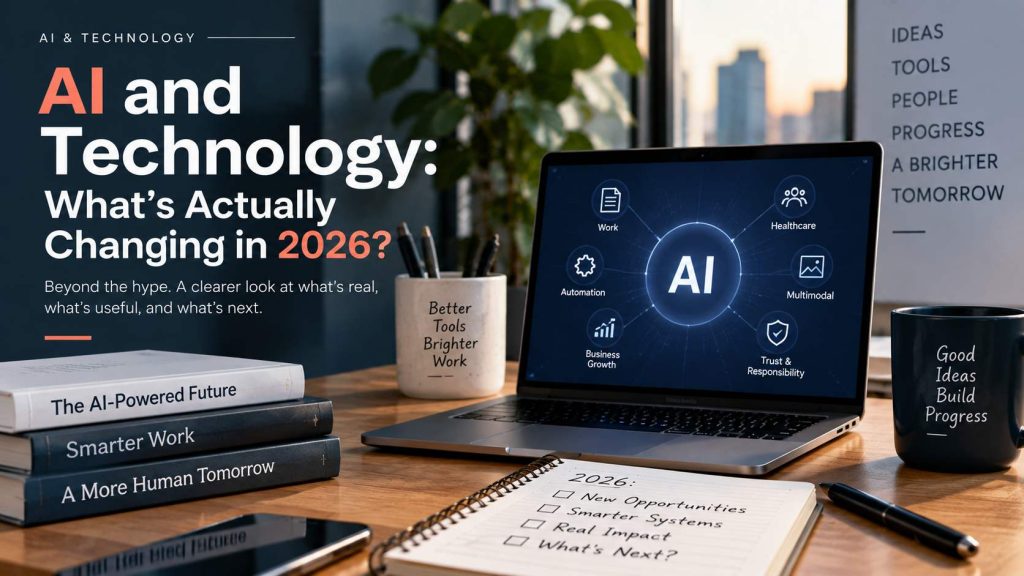
A few years ago, most conversations about artificial intelligence centred on a single question: can it write, draw, or code something impressive? That question has largely been answered. The more interesting question now is what happens after the demo ends, when a business, a hospital, or a small team tries to fold AI into work that actually has to get done every day. That shift is the real story of AI and technology this year, and it’s worth unpacking in some detail.
From Impressive Demos to Working Systems
For a long time, AI progress was measured in flashes of novelty: a chatbot that could hold a conversation, an image generator that could paint a scene from a sentence. Those milestones mattered, but they didn’t tell you much about whether the technology could hold up under the weight of a real job.
That’s changing. Across industries, the conversation has moved from “look what this model can do” to “does this actually save time, reduce errors, and fit into how we already work.” Agentic AI – systems that don’t just answer a question but carry out multi-step tasks on their own. These tools can now research a topic, sort through support tickets, draft a proposal, or pull information out of a stack of documents. The catch is that they still work best with a person checking the output before anything gets sent, priced, or published. Full autonomy hasn’t won out over human oversight and for tasks involving legal risk, pricing, hiring, or brand reputation, that oversight isn’t optional.
Multimodal Is the New Baseline
Another shift worth noting is how ordinary “multimodal” has become. Not long ago, a model that could handle text, images, audio, and video all at once felt like a novelty. Now it’s closer to a baseline expectation. Systems that can read a screenshot, listen to a call recording, and scan a PDF in the same workflow are proving far more useful in sales, support, legal, and training contexts than any single-purpose tool. The practical value here isn’t the multimodality itself, it’s what that capability lets a small team skip. Instead of manually transcribing a call and then separately summarizing a document, one system can do both and hand you something usable.
Alongside this, there’s a growing appetite for smaller, more specialized models rather than always reaching for the biggest one available. Smaller models are cheaper to run, easier to control, and often good enough for a narrow, well-defined task which matters a lot to teams watching costs closely.
Healthcare Is Leading, Not Following
If you want a sense of where AI is proving its worth fastest, healthcare is a good place to look. Remote care tools, hospital operations software, and support systems for clinical staff are seeing some of the strongest momentum of any sector this year. The reason isn’t mysterious: hospitals and care teams are willing to pay for tools that cut down on documentation time, triage patients faster, and ease scheduling and staffing pressure. That’s a very different adoption story than the consumer chatbot boom of a few years back.
The Rise of Persistent, Context-Aware Assistants
One quieter trend that’s easy to overlook is the move toward AI systems that remember things. Persistent assistants: tools that retain context about a business, a project, or a customer across sessions are becoming more valuable precisely because they cut down on repeated setup. Instead of re-explaining your business every time you open a new chat, the system already has the relevant history. For small teams especially, this starts to look less like a chatbot and more like an assistant that’s actually been paying attention.
What This Means, Practically
Pulling these threads together, a few practical takeaways stand out for anyone trying to make sense of AI and technology news right now:
• Judge tools by the workflow they replace, not the demo they show. A model that looks impressive in a five-minute video isn’t the same as one that holds up across a week of real use.
• Keep a human in the loop for anything high-stakes. Legal, financial, medical, and brand-sensitive decisions are still better made with AI assistance rather than AI autonomy.
• Multimodal capability is worth prioritizing if your work involves documents, screenshots, or recordings in addition to plain text.
• Smaller or specialized models are often the smarter choice for narrow, repeatable tasks, both for cost and control.
• Data handling deserves real scrutiny. Ask concrete questions about retention, training use, and where data is stored before adopting a new tool, rather than taking marketing claims at face value.
Where This Leaves Us
None of this means the hype has disappeared entirely, there’s still plenty of noise, and not every “AI-powered” product delivers on what it promises. But the centre of gravity has shifted from spectacle toward usefulness. The organizations and individuals getting real value out of AI right now aren’t the ones chasing the flashiest new release. They’re the ones treating these tools like capable but supervised team members: useful for drafting, sorting, and summarizing, but not yet trusted to make the final call.