
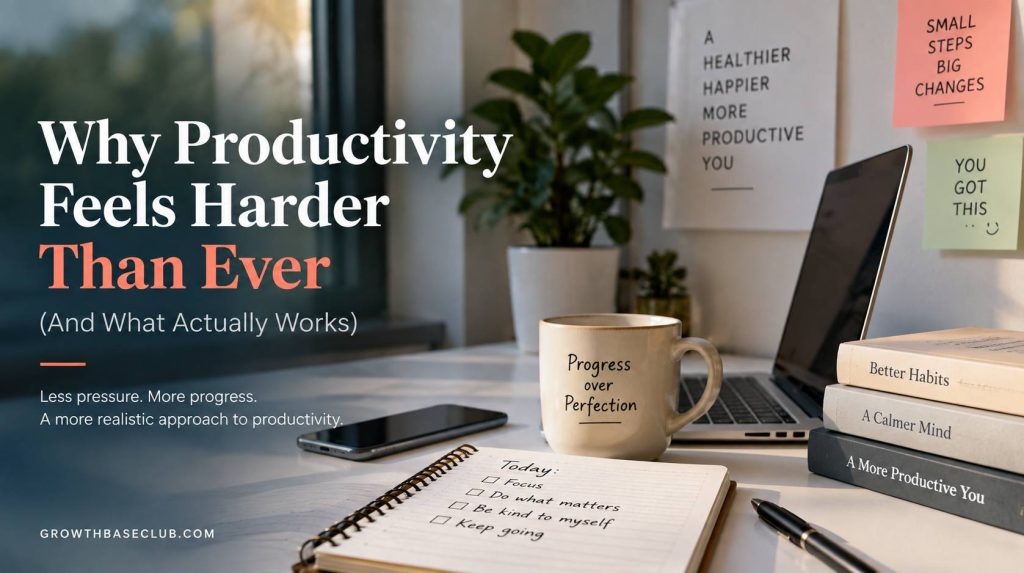
Why Productivity Feels Harder Than Ever (And What Actually Works)
I used to keep a spreadsheet. Color-coded tabs, a whole tab just for "systems." It lasted about three weeks before I quietly stopped opening it. If you've done something similar, you already know where this is going. Scroll LinkedIn for five minutes and you'll find someone selling the 5 AM club, or a "perfect" Notion setup, or a morning routine with eleven steps. Most of it doesn't work, not because the people sharing it are lying, but because it was built for their brain, their job, their life. Not yours. The advice that sounds smart but isn't A few things get repeated so often people stop questioning them."Work more hours." Past a certain point, more hours just means the same output stretched thinner. Most people have maybe four or five hours a day where their brain is genuinely sharp - the rest is momentum."Multitask to get more done." Switching between tasks has a real cost. Every time you jump from an email to a doc back to Slack, you're paying a tax in attention, even if it doesn't feel like it at the moment."You have to be a morning person." Some people do their best thinking at 6 AM. Others don't wake up properly until 10. Forcing yourself into someone else's schedule usually just makes you tired and unproductive."Wait until you feel motivated." This one gets people stuck for months. Motivation tends to show up after you start, not before. The fix is almost embarrassingly simple: do a tiny, low-stakes version of the task and see what happens."Habits form in 21 days." That number came from a book about plastic surgery patients in the 1960s, not a habit study. Real behavior change research points closer to two to three months, and it varies a lot person to person. None of this is a character flaw. It's just advice that never fits in the first place.What actually helpsProtect your energy, not just your calendar. Figure out when you're sharpest, for a lot of people it's a two or three hour window and guard it like it's expensive, because it is. Put the hardest task there. Let easier stuff fill the low-energy hours. Chase impact, not a full checklist. Finishing ten small things can feel more satisfying than finishing one big thing, even when the big thing mattered more. Before diving into a task, it's worth asking whether it'll still matter in a year. If not, it can probably wait.Build habits that are almost too small to fail. Big overhauls rarely survive contact with a bad week. A two-minute journal entry, one small step on a big project, showing up even at 20%, that's what actually compounds. And when things get chaotic, scale the habit down instead of dropping it entirely.Keep learning, and let feedback sting a little. Skills go stale faster than people expect. A short course, a blunt piece of feedback from someone you trust, an honest look at what's not working, these do more for a career than another productivity app ever will.Design your space so you don't need willpower. Phone in another room during focus time. Calendar blocks that actually get honored. Templates for the emails you write fifty times a year. The less you have to decide, the more energy is left for the work that matters.Procrastination especially gets misread as laziness when it's usually about avoiding a feeling l dread, boredom, fear of doing it wrong not about being undisciplined. Naming that feeling usually does more than another productivity hack ever will.Finally, The internet will keep inventing new systems to sell you. Most of them aren't necessary. Protect your energy, focus on what actually matters, build small habits, keep learning, and set your environment up so discipline isn't doing all the work. That's most of it..